
About Hwinzo
The Name
Hwinzo means “far away” in Gitonga, the language spoken in Inhambane Province along this stretch of the Mozambican coast. It is the language of the Mutamba River potters, who have shaped clay from this land for generations. It is also the language in which libumba means clay.
“Far away” is not only a description of place. It is a description of feeling: distance from noise, urgency, and the pressures that accumulate in daily life; proximity to the things that are often crowded out — quiet, attention, craft, conversation, and time.
The People
Tim McKulka Tim spent fifteen years as a photojournalist covering global news, dedicating seven of those years to documenting the transformation of Sudan and South Sudan — capturing the birth of new nations and the resilience of the people living through them. His work has produced two books and international exhibitions. In Mozambique he founded Libumba, a ceramics studio and cultural preservation project rooted in the clay of the Mutamba River.
Anyieth D'Awol Anyieth is a South Sudanese human rights lawyer whose career has been built on creating structures where none existed. She founded The Roots Project in Juba, a craft cooperative where women from 22 different tribes have worked together for over fifteen years. She is currently a faculty member at the Center for Mind-Body Medicine, leading CMBM-Africa, an initiative delivering trauma relief across the continent.
Tim and Anyieth arrived in Mozambique in 2013 and established their home at Hwinzo with their three daughters. The residencies, gatherings, and programs hosted here grow from the same values they have carried across their work — a deep commitment to place, a pursuit of honesty, and the patient, vital work of repair.
The Land & The Network
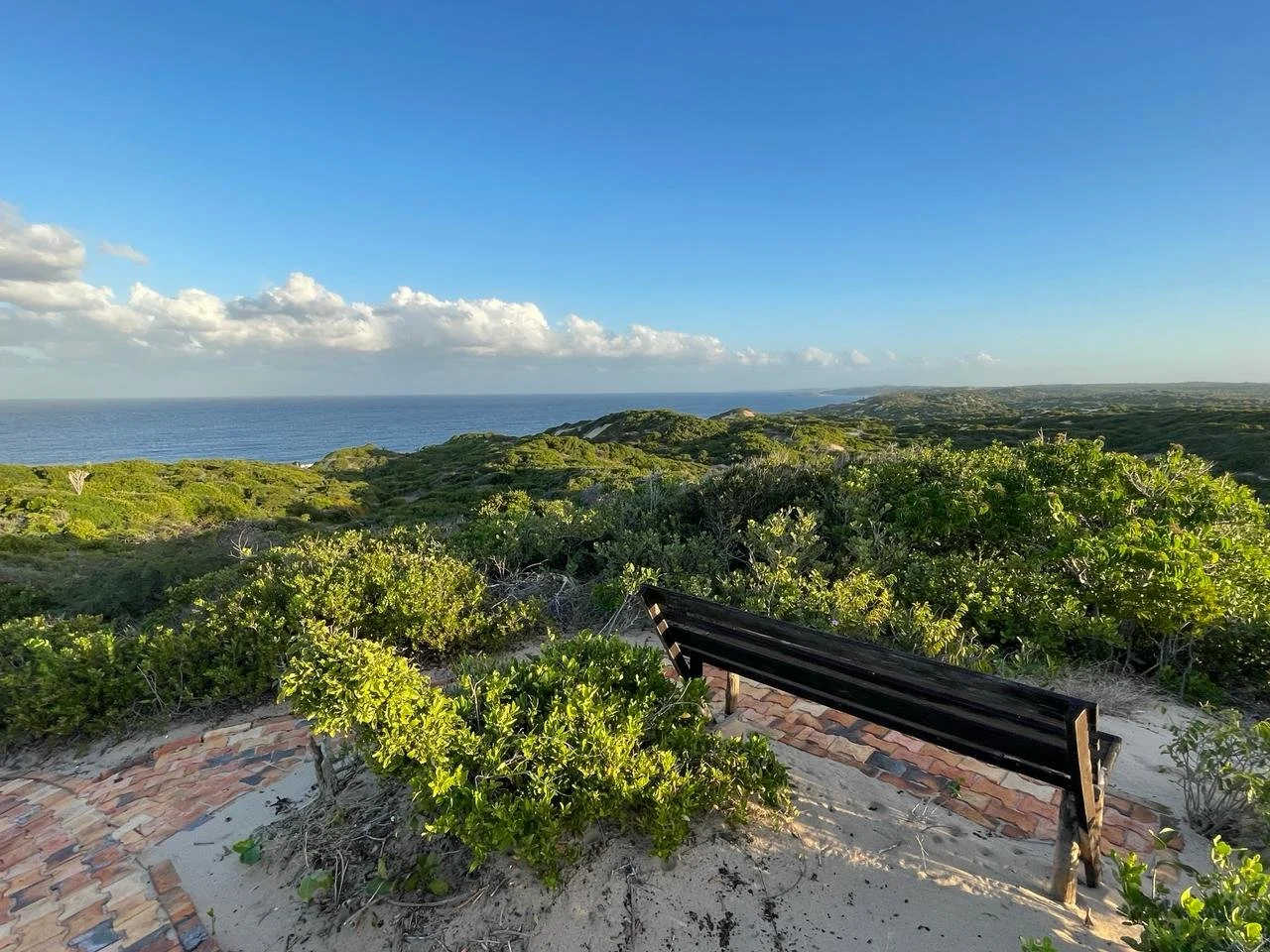
Hwinzo sits on six hectares of primary coastal dunes and indigenous forest overlooking the Indian Ocean. The property is planted with native species, maintained by borehole water, powered by solar energy, and built with terracotta bricks laid by hand over more than a decade.
Hwinzo is one part of something larger. Everything here is connected.
Libumba, the ceramic brand Tim runs, produces the tiles around the pool, the lamps hanging in every room, and the plates on the table. Its clay comes from the Mutamba River, 40 kilometers south. When you eat at Hwinzo, you eat from Libumba.
ALMA Tofo has helped turn local waste into part of Hwinzo’s architecture. In the main bedroom, the walls were built using an innovative technique that fills the wall cavity with 4,000 plastic bottles and approximately 150,000 plastic bags. In total, 1.5 tonnes of plastic from Tofo’s waste stream was repurposed as thermal insulation, making the room cooler in the wet season and warmer at night. The technique is now used throughout the property.
Roots of South Sudan, Anyieth’s nonprofit, works 4,000 kilometers away in Juba, but the same principle runs through it: that women making things together — beadwork, ceramics, food, community — is a form of repair that reaches deeper than policy.
CMBM-Africa is the continent-wide network of Center for Mind-Body Medicine facilitators trained at Hwinzo and now serving their communities across six African countries.